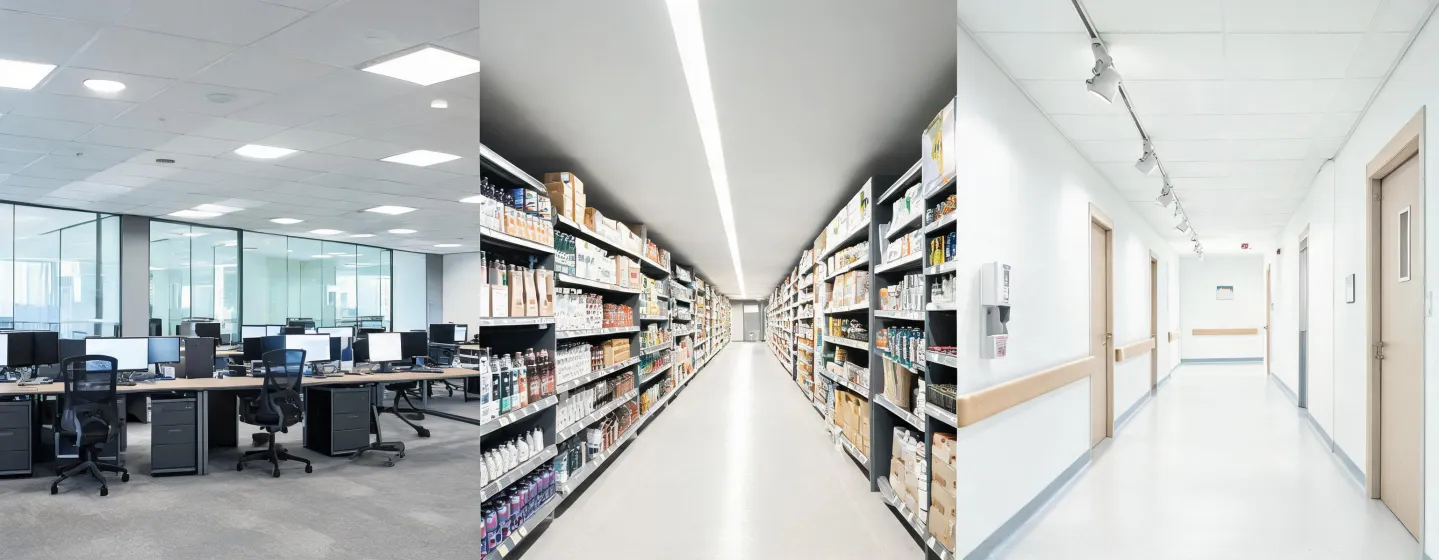
Commercial lighting applications across office and retail
Application guide

Savant lighting for spaces with different visual tasks

Start with occupancy, task contrast, ceiling and maintenance conditions—then compare optics, output and controls.

Office and education

Open work areas and classrooms need controlled source brightness, useful vertical illumination and flexible zoning. Compare UGR context, 3500 K or 4000 K choices, Ra 80 or 90+, occupancy sensing and daylight harvesting against the room geometry.

Typical scale
20–200 luminaires per floor or teaching wing
Verification
IES calculation, control narrative and emergency coordination

Retail and hospitality

Merchandise and finishes place more weight on color rendering, beam control and visual hierarchy. Higher CRI may reduce efficacy or available lumen packages, so energy and appearance targets should be compared with physical samples.

Typical mix
Track, recessed accent and linear ambient lighting
Verification
Mock-up, TM-30 context and aiming plan

Healthcare and public circulation

Examination, waiting and corridor zones have different illuminance and glare needs. Cleaning protocols, emergency operation and night-time control scenes add constraints beyond a single maintained-lux target.

Key boundary
Product certification does not replace local healthcare requirements
Verification
Room-by-room schedule and controls sequence

Commercial retrofit

Existing apertures, branch wiring, ceiling depth and control conductors determine what can be installed without rework. Wireless or distributed control may reduce new wiring, while centralized control can provide clearer portfolio policies.

Survey inputs
Voltage, aperture, plenum, circuit and existing dimming method
Verification
Sample fit, load test and commissioning plan
Decision checklist

Compare trade-offs before naming a family

Efficacy versus visual comfort: maximizing lm/W reduces system power, while lower glare, higher CRI and refined distribution can better serve occupants. Neither priority applies universally.

Centralized versus distributed controls: centralized supervision simplifies common policy; distributed zoning can improve local flexibility and fault isolation. Network maintenance and commissioning ownership influence the choice.

Integrated versus replaceable components: integrated systems can be compact and thermally controlled; replaceable drivers and light engines may lower future service cost when access and compatible spares are planned.

Bring one representative room

We will help frame a repeatable selection method for the wider project.